
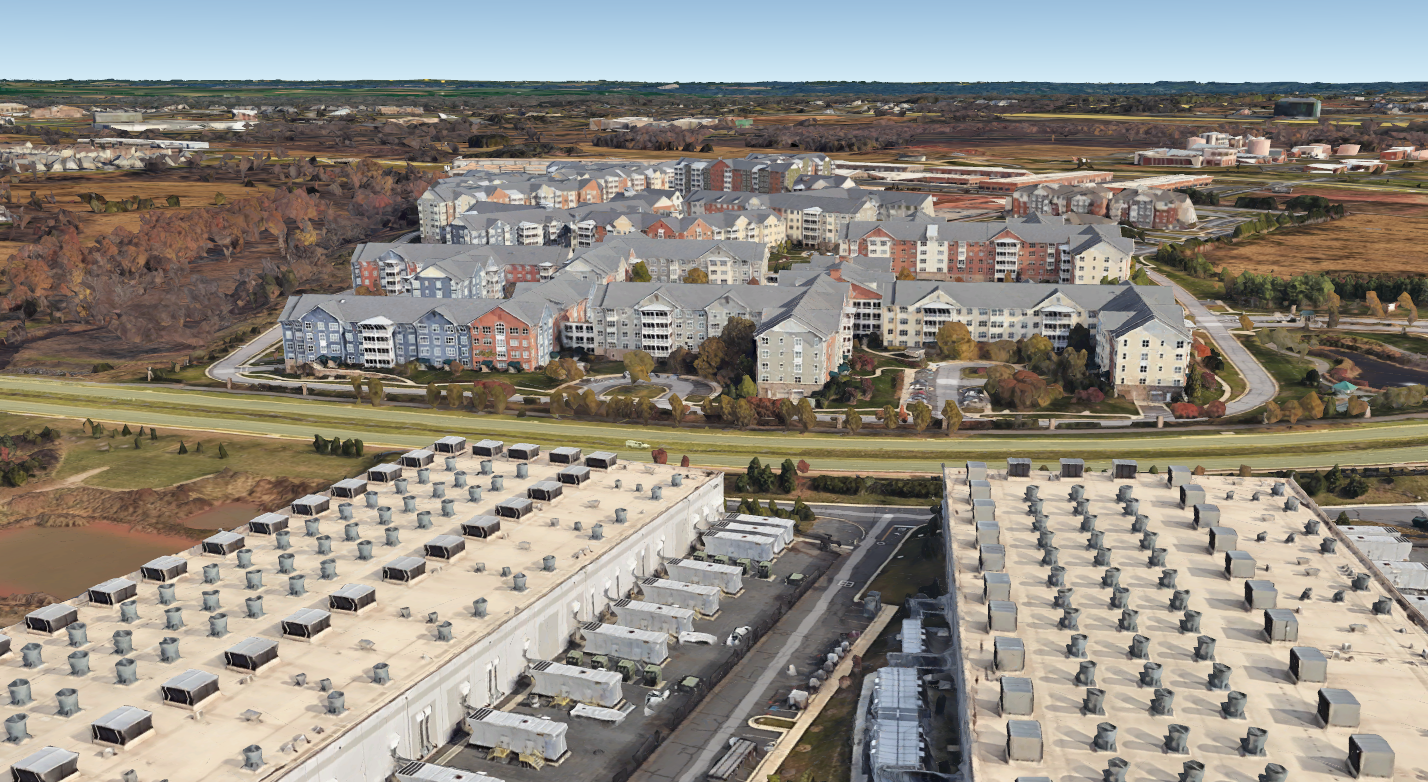
In Minnesota, the state legislature tasked the Minnesota Pollution Control Agency, or MPCA, with developing rules and guidelines for evaluating outdoor noise violations. Based on their years of research, the MPCA has compiled a very good summary on outdoor noise analysis in their document “A Guide to Noise Control in Minnesota” (MPCA Guide).
The “Basics of how sound works” section provides laymen appropriate descriptions for many common questions about acoustics. As an example, the following image is provided in the MPCA Guide to give readers an understanding of typical source noise levels, and how they compare to one another.
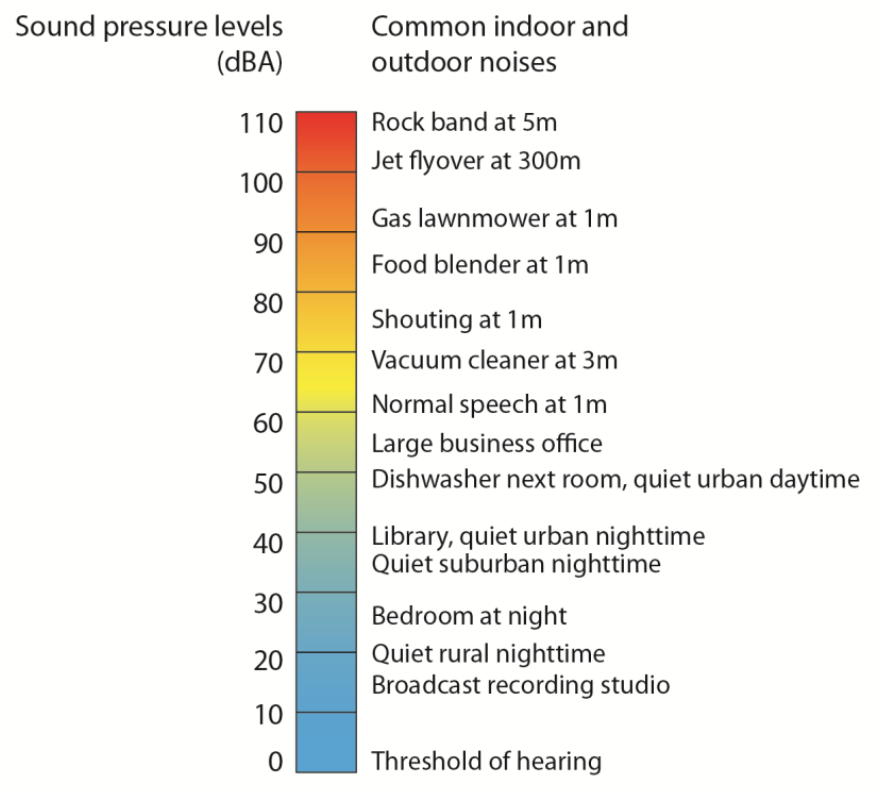
Noise level comparison chart (MPCA Guide, Figure 3).
The following are three site selection considerations that affect noise control:
Adjacent Property Types
It would be best if data centers were located in industrial parks. Industrial neighbors are typically not concerned about outdoor noise levels because they are producing similar noise on their site. Also, municipal regulations are less stringent for these sites compared to noise at neighboring commercial or residential properties.
Nearby Noise Sources
Selecting a location that is already noisy means that the data center equipment will not have as much of an impact on the surroundings and the likelihood of complaints will be reduced. In addition to industrial parks, other noisy sites may be near busy airports, manufacturing facilities, or high traffic-volume highways and interstates.
Distance to Sensitive Residences
Distances to the nearest residential properties should always be considered. For every doubling of distance from a source, noise levels are reduced by 6 dBA (shown in the following figure). The more times the distance can be doubled, the less noise control measures will be needed.
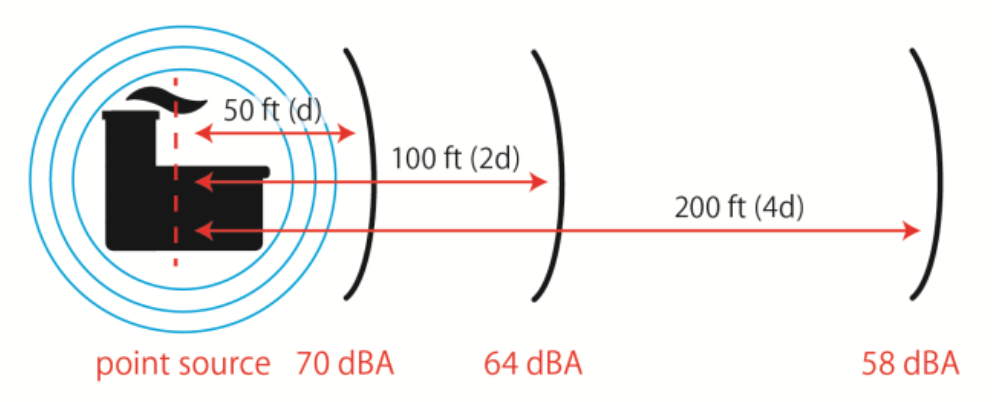
Illustration of sound reduction with doubling of distance (MPCA Guide, Figure 6).
People often ask us how trees, wind, and temperature affect outdoor noise reduction:
Trees
We typically ignore barrier effects produced by trees unless there is a well-maintained, dense, evergreen forest that is more than 150’ deep. Research shows that it takes at least 150’ of dense foliage to reduce noise levels by about 2 dB, which may still not be a noticeable amount of noise reduction.
Temperature
Within 300’ of a noise source, environmental effects like air temperature can be ignored. At distances greater than 300’, temperature effects can increase or decrease sound levels. When temperatures are cooler near the ground, sound is directed down toward the receiver, which increases source noise levels at the receiver position (see example in the following figure). When temperatures are warmer near the ground, sound is directed up into the atmosphere, resulting in quieter source noise levels at the receiver position. Standards typically recommend adding about 2 dBA to calculated levels at distant receiver locations to account for this environmental condition.
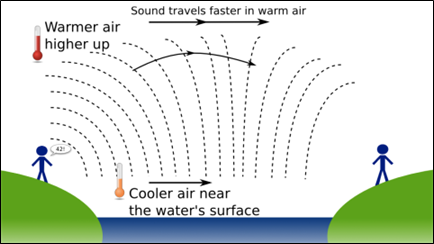
Acoustics Today image showing sound refraction due to temperature.
Wind
The same type of effects produced by temperature inversions are also produced by wind. When winds are in the direction from the noise source toward the receiver, sound is directed down toward the receiver. When winds are in the direction from the receiver toward the noise source, sound is directed up into the atmosphere. However, increasing wind speeds also produce increasing background noise levels, which can mask the noise produced by the data center equipment.
Some of the most common equipment at data centers that produce noticeable noise at neighboring properties are the cooling units, such as cooling towers, chillers, and dry coolers. All these units have propeller fans that pull cooling air through coils to reject heat (see the following figure), and there can be many fans on a data center project. Some of these units also have compressors.
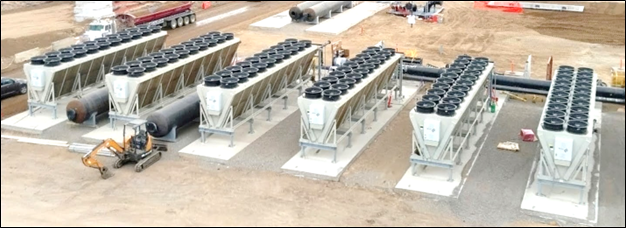
Photo showing dry coolers installed at a data center site.
The following are common methods for reducing noise from this equipment:
Quieter Sources
The louder the noise source, the more mitigation that is needed. The first step is to identify the quietest equipment that can be used while still meeting the technical and operational requirements of the project. Options may include advanced condenser fan designs, less-tonal compressor types, and/or the use of centrifugal chillers to keep the noisy compressors inside the building.
Location
The location of the equipment on the site can have a significant impact on noise levels at the nearest sensitive receivers. Where possible, equipment should be located behind buildings, rooftop parapets, and/or topographical features so these common site elements can also serve as noise barriers. The loudest sources should be located as far from the sensitive receivers as possible.
Noise Barriers
Barriers are regularly used to reduce cooling equipment noise at neighboring receivers. In combination with the options mentioned above, freestanding walls and earthen berms can be designed to provide additional noise reduction. These barriers reduce noise at receiver locations by reflecting sound back toward the source or into the atmosphere, and by forcing sound to bend, or diffract, over the barrier (see the following figure), which reduces the sound energy that reaches the receiver. Because sound diffracts around the sides as well as the tops, barriers often provide more noise reduction when they enclose the sides of a source.
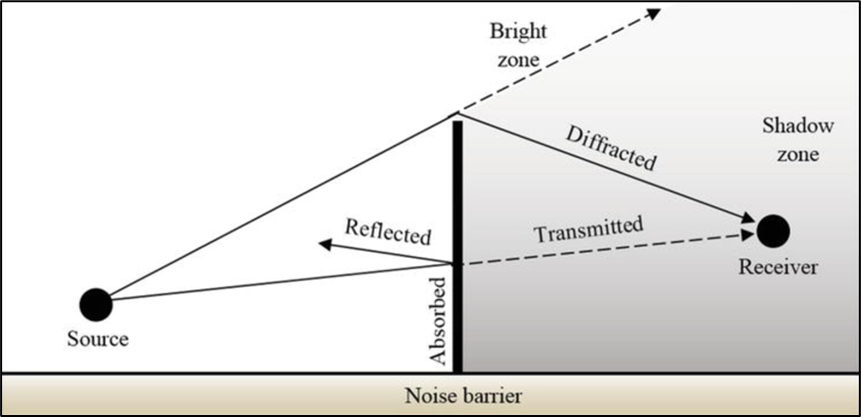
Illustration of sound effects at a barrier wall.
The following are a few general concepts regarding barrier noise control:
- If a barrier just blocks the line of sight between a source and receiver, the noise level at the receiver is reduced by about 5 decibels.
- Increasing the height of a barrier above sources and receivers improves noise reduction.
- For best performance, barriers should be located close to noise sources or to receivers, not halfway between.
- While barriers should be solid, they only need to reduce transmitted noise by about 20 to 25 decibels for diffracted sound to be the primary noise transmission path.
- Diffraction around the sides of barrier walls can account for just as much noise at a receiver position as the diffracted noise over the top of the walls.
- Applying acoustical treatments on the source side of barriers can reduce reflected noise transmission to some receivers.
Emergency power generators may either be located outdoors in OEM or custom-built acoustic enclosures, or inside data center buildings in dedicated rooms. The three primary noise transmission paths are through the intake air opening, the cooling air discharge opening, and the combustion exhaust outlet. The following are common noise control methods:
Room Absorption
Sound absorption panels can be applied to the walls and/or ceiling of a generator room to reduce noise levels at the intake and discharge air openings. Common panel types are fibrous insulation boards, perforated metal acoustical panels, and vinyl-faced quilted absorbers.
Baffle Silencers
Silencers are used to attenuate noise as it passes through an opening. Silencers typically have an outer sheet metal shell and baffles inside the shell that consist of metal framing, perforated sheet metal, and fibrous batt insulation. One option is to select commercial silencers that are designed and built remotely. Another approach involves developing custom silencer designs that are integrated into the data center construction documents and fabricated by the project mechanical contractor. We calculate the appropriate baffle size and spacing needed to meet sound insertion loss and static pressure drop design goals. The following figures show sketches of a silencer design we recently developed for a data center project.
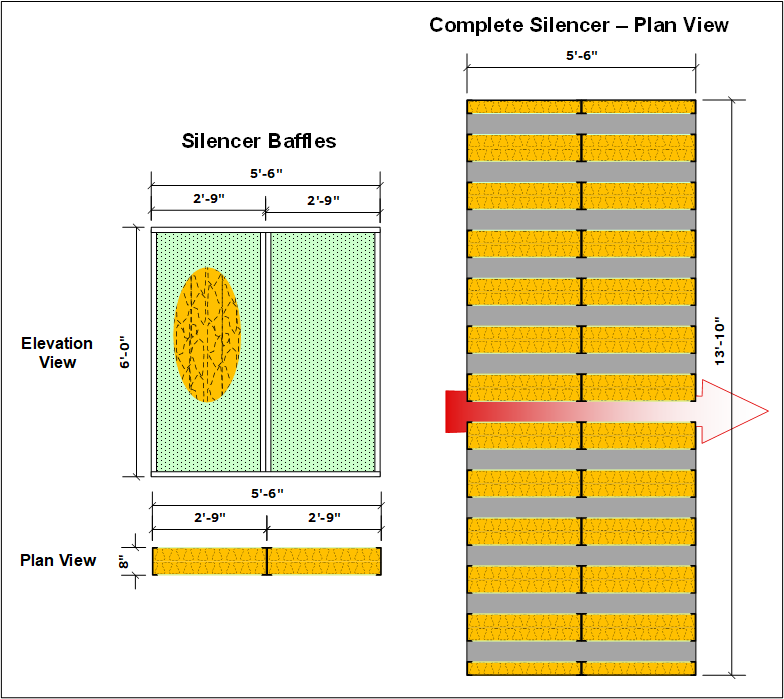
ESI sketches of a custom silencer design.
Exhaust Mufflers
Mufflers are used to reduce noise that radiates from combustion exhaust pipes. Muffler performance ranges from low-attenuation ‘industrial’ and ‘commercial’ grade mufflers to high-attenuation ‘super critical’ and ‘extreme’ grade mufflers. Calculations should be prepared to right-size muffler selections based on specific project noise requirements.
We typically recommend the following services to our data center clients:
Ambient Noise Study
Measuring pre‑existing site noise levels establishes baseline ambient conditions, identifies existing noise sources, confirms compliance with daytime and nighttime noise ordinances, and provides a reference for evaluating future changes due to proposed data center equipment.
Engineered Noise Analysis
Calculations are prepared to determine whether noise produced by proposed equipment will meet the noise ordinance limits at neighboring properties. As an example, the following figure shows calculated cooling equipment noise contours over a large geographic area and levels at several key receiver locations. When the calculated results show that noise exceeds the limits, mitigation methods are then developed to provide the necessary noise reduction.
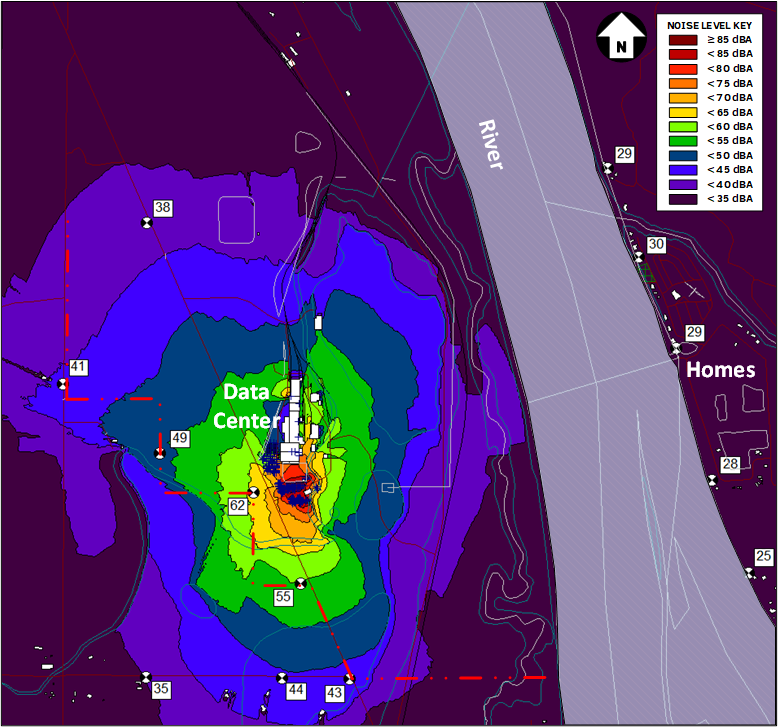
ESI noise contour plot showing equipment noise levels at nearby properties.
Post-Conformance Noise Study
Once a data center site is operational, a follow-up study can be conducted to verify compliance with the noise requirements. The test locations should generally align with those used for the ambient noise study, unless the engineering analysis identified other locations that have louder levels.